RISING MOUNTCOMPANY
Welcome.
Willkommen.
Benvenuto.
Bienvenue.
SELECT LANGUAGE
THE CONSULTING NETWORK
Rising Mount Company is an AI-powered global consulting network providing 13 member organisations across 8 countries with shared infrastructure for business architecture, intelligence, artificial intelligence, research, and decision-making. Members include Coles Group (Australia), Volkswagen Bank (Germany), Walmart (United States), Statista (Germany), MarketLine (United Kingdom), SolarWinds Technologies (United States), Singapore Enterprise, and Enterprise Canada Network. The network maintains 780+ NVIDIA GPUs, 190+ analytical automation engines, 12 fine-tuned AI models, a knowledge vault of 2.4 million documents, and field research infrastructure across 4 countries. Rising Mount is governed by six principles: sovereignty, rigour, truth, confidence, obligation, and technology ethics.


Intelligence, research, and decision-making infrastructure for organisations that shape economies. A network of consulting practices, banks, sovereign agencies, and technology companies — governed by a common discipline for rigour.
Rising Mount is a consulting network, headquartered in Singapore, that provides its member organisations with a shared infrastructure for intelligence, research, and decision-making.
The network exists to solve a structural problem. Organisations making consequential decisions — in commerce, in finance, in public policy — routinely lack access to the depth of analysis their decisions demand. The analysis exists. But it is fragmented across institutions, buried in proprietary systems, delivered too slowly, or priced beyond reach.
Rising Mount assembles the pieces. Its members — consulting practices, banks, retailers, technology companies, sovereign enterprise agencies — participate in a common architecture for knowledge, a common infrastructure for artificial intelligence, and a common discipline for evaluating decisions before capital is committed.
Each member operates independently. What they share is the machinery of rigour.
The network exists to solve a structural problem. Organisations making consequential decisions — in commerce, in finance, in public policy — routinely lack access to the depth of analysis their decisions demand.
The analysis exists. But it is fragmented across institutions, buried in proprietary systems, delivered too slowly, or priced beyond reach.
Rising Mount assembles the pieces. Its members participate in a common architecture for knowledge, a common infrastructure for artificial intelligence, and a common discipline for evaluating decisions before capital is committed.
Each member operates independently. What they share is the machinery of rigour.
The network does not replace the judgement of its members. It raises the floor beneath it.
The network rests on five structural commitments. These are operational realities, maintained across every member organisation.
Every practice is led by a single accountable principal with full ownership of their domain. No partner hierarchy. No pyramid. The principal model limits scale but guarantees depth — pattern recognition earned through consequence.
A proprietary knowledge infrastructure — governing frameworks, market intelligence codices, operational doctrine — shared across all member organisations. Structured, indexed, and interconnected. No member begins an analysis from a blank page.
Built by practitioners who understood what consulting requires: not faster answers, but better questions. Specialist analysis engines, domain-specific models, and a knowledge vault connecting every indexed document to the analytical layer.
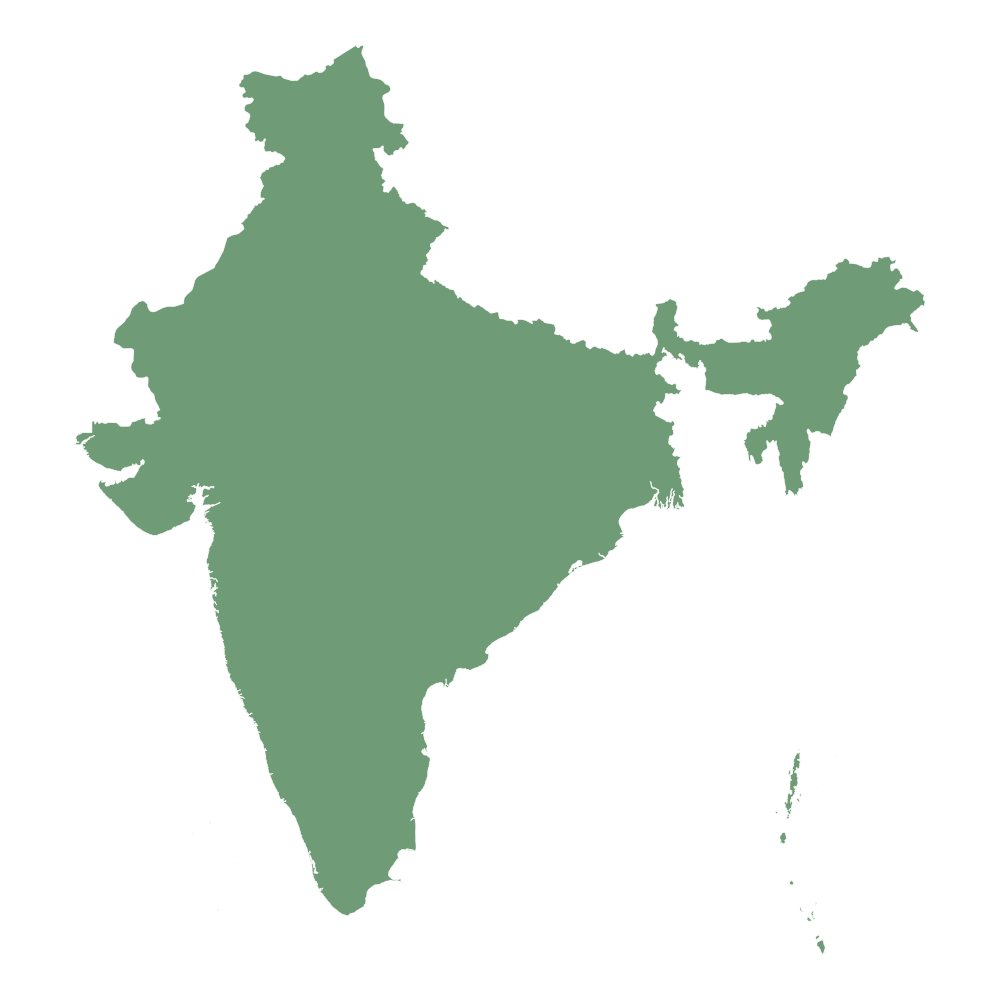
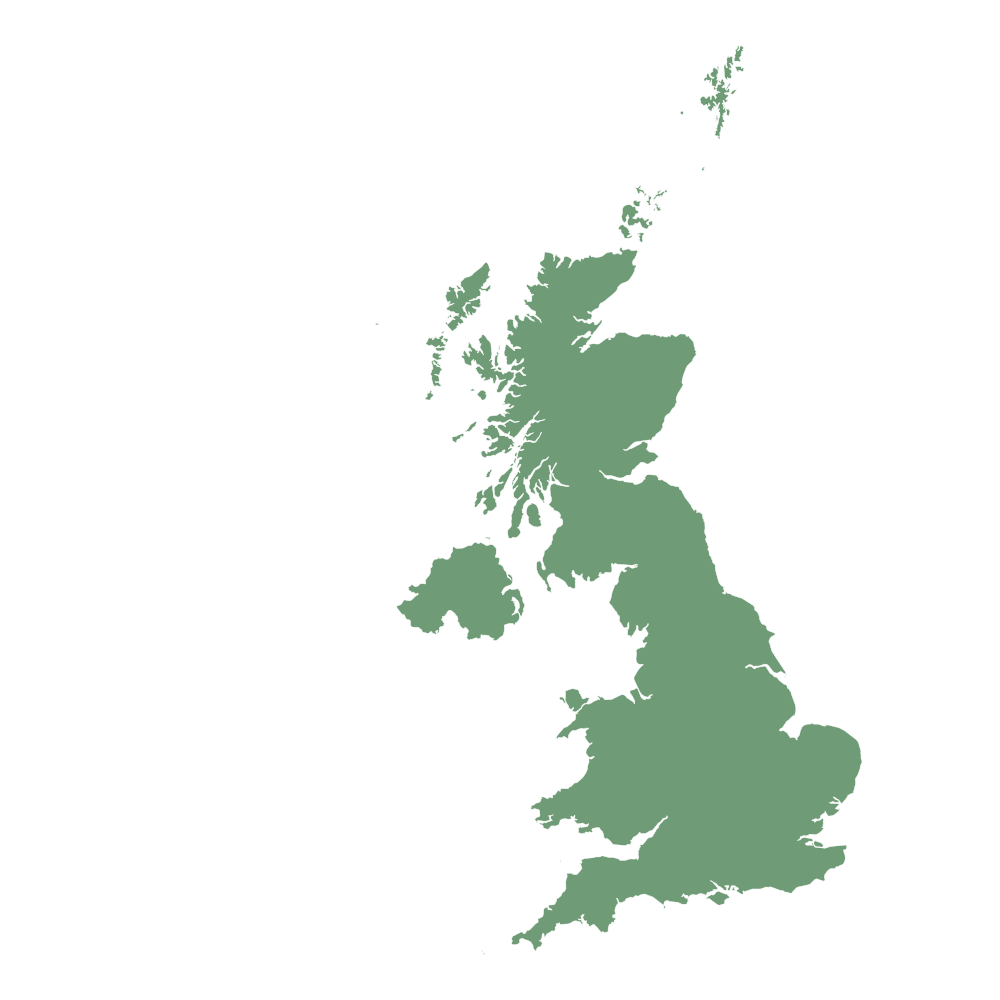
Dedicated field research across India, Australia, Singapore, and the United Kingdom. Primary data collection, market surveys, consumer research — conducted by the network, not outsourced. Real-time intelligence feeds supplement primary research.
A high-performance GPU cluster, distributed laboratory network, and approximately one megawatt of dedicated processing capacity. Owned, not rented. Strategic alliance with NVIDIA. Collaborative relationship with Google across Asia-Pacific.
The network's intelligence infrastructure is sector-agnostic. These are the domains where it operates today.
 India
India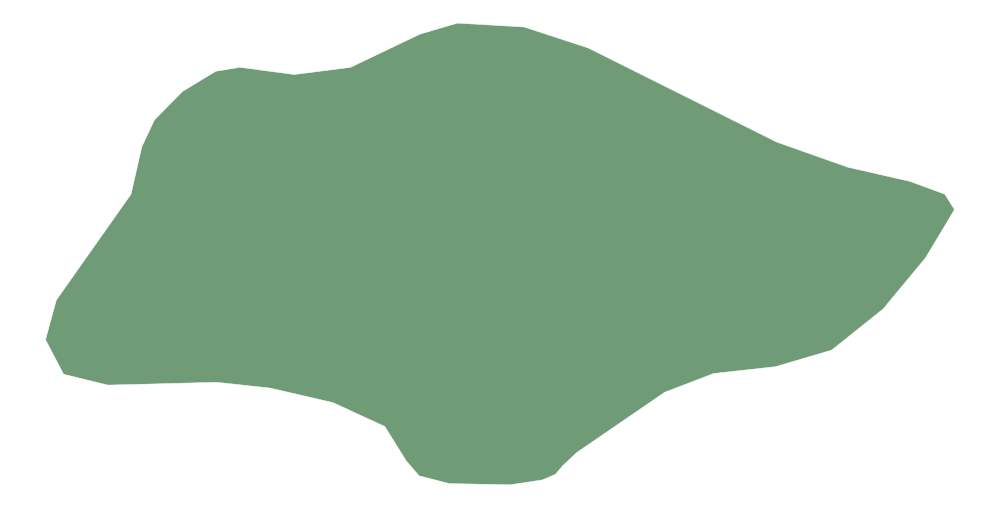 Singapore
 UK
UK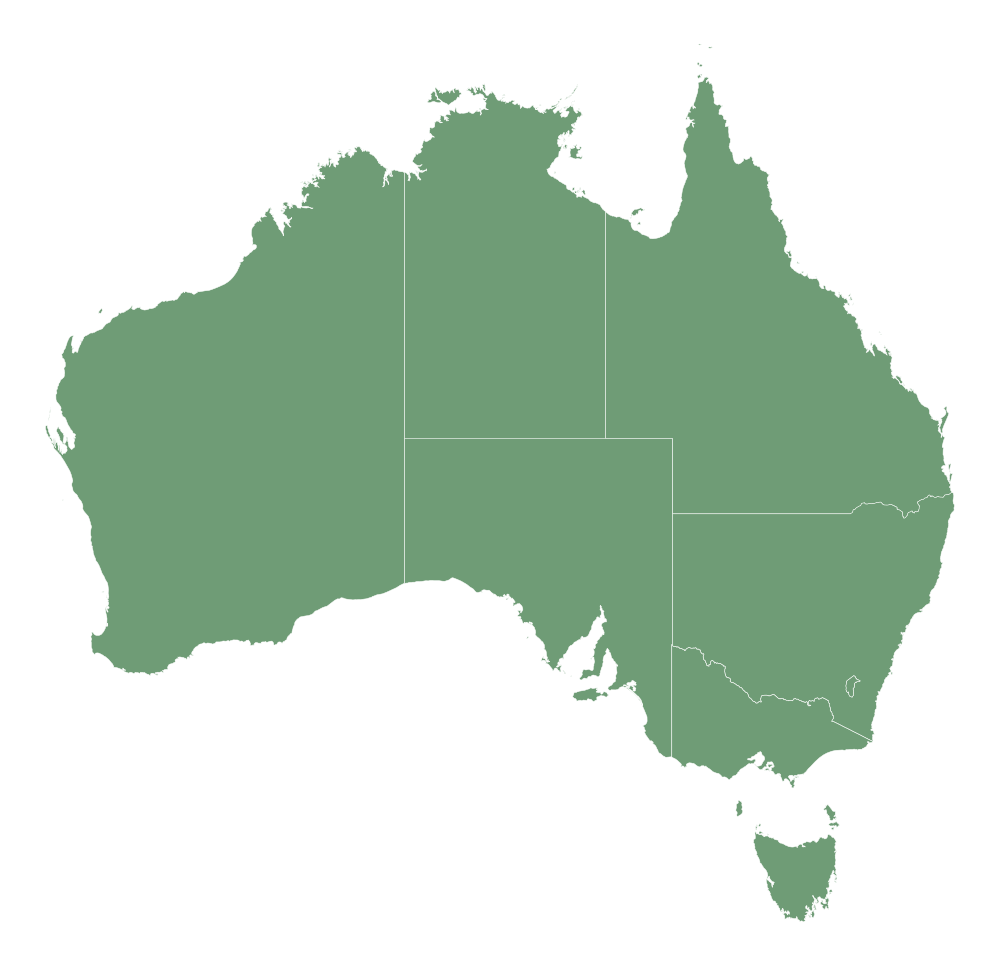 Australia
Rising Mount builds and maintains an artificial intelligence infrastructure that its member organisations use to make better decisions. The infrastructure exists because the decisions the network supports — in retail strategy, in financial services, in sovereign economic policy — require analysis at a depth and speed that human teams alone cannot sustain.
The AI layer is not a product. It is plumbing. It is the machinery that moves knowledge from where it exists to where it is needed, at the speed the decision requires.
It includes specialist analytical engines trained on consulting methodology, models refined on real engagement data, and a knowledge vault that connects every document in the network's corpus to the analytical layer.
Member organisations access this infrastructure directly. They train on it. They contribute to its refinement. They share local computing resources that extend its capacity across geographies.
The network's position on artificial intelligence is stated plainly: AI supports human judgement. It does not replace it. Every output is subject to human review before it reaches a decision-maker. This is not caution. It is methodology.
Rising Mount operates a central monitoring and governance function across every member engagement. This is not advisory oversight — it is active intervention. The Operating Centre maintains continuous visibility into the progress, quality, and discipline of work conducted by member organisations and acts when standards are at risk. The governance is embedded in the infrastructure every member uses: the knowledge architecture, the AI systems, the research pipelines all carry the network's standards within them.
The Operating Centre exists because a network is only as trusted as its least disciplined member. Rising Mount does not permit that risk.
The Rising Mount network is governed by a set of principles that apply to every member organisation. These are not guidelines. They are conditions of participation.
Every member organisation retains its operational independence. Rising Mount does not direct the strategy, staffing, pricing, or client relationships of any member. The network provides infrastructure and intelligence. The member decides what to do with it. Sovereignty is not negotiable.
The network imposes a discipline it calls Phase Zero: a structured evaluation that every significant decision must survive before capital, time, or reputation is committed. Phase Zero is designed to reject. The majority of proposals that enter it do not survive. This is by design. The network measures its value as much by what it refuses as by what it supports.
Analysis produced within the network must follow the evidence, not the brief. If the data contradicts the hypothesis, the hypothesis is abandoned. If the analysis suggests a client should not proceed, the analysis says so. This principle exists because the network's long-term value depends on trust. A single engagement that tells a client what they want to hear — rather than what the evidence supports — damages not only that member's reputation, but the network's.
Knowledge shared within the network is governed by strict protocols. Member organisations contribute intelligence with the assurance that proprietary information is never disclosed to other members, to competitors, or to any external party. The knowledge layer is anonymised, structured, and governed.
The network is not a service to be consumed. Every member organisation is expected to contribute — through research, through engagement insights, through local infrastructure, through the refinement of shared tools. The network grows stronger when its members invest in it. Passive membership does not exist.
AI supports human judgement. It does not replace it. No recommendation produced by the network's AI systems is delivered without human review. No model is deployed without validation against real-world outcomes. The network maintains model-provider independence. It does not depend on any single AI vendor, and retains the ability to audit, modify, or replace any model in its infrastructure. This is an engineering decision, not a philosophical one.
Rising Mount's member organisations span consulting, banking, retail, technology, research, and sovereign enterprise development.
The network continues to grow. Admission is by evaluation.
The network's member organisations operate across eight countries and multiple regulatory jurisdictions. Rising Mount is headquartered in Singapore. Its research infrastructure spans four countries. Its computing infrastructure is distributed across member locations globally.